Monday, January 26, 2026

Winter Storm Reads: Our Winter Monster by Dennis Mahoney & Snow Country by Yasunari Kawabata

Since the winter storm is keeping us indoors another day, I thought I'd share two books about snow I've read this month. 

Published a year ago this week, Our Winter Monster by Dennis Mahoney is about a couple whose relationship is on the rocks being terrorized by a swirling mass of snow. Really! 

The story alternates between Brian and Holly present and Brian and Holly a year ago before a traumatic, bloody event that left them both, separately and together, changed. In the present narrative, they take a spontaneous vacation to a ski village but are derailed en route by a snow storm that has the power to yank someone out through a car window.  

We also get chapters from the village sheriff's perspective. Up until recently, Kendra felt confident and content, but then her girlfriend left her, two tourists went missing, and now she feels like a failure, stranded in an interior blizzard. 

Kendra, Brian, and Holly will encounter an unexplainable phenomenon before the night is through. 
This is an enjoyable, non-literary, old-fashioned horror story: It is a fun read that is also about the ways we avoid dealing with traumatic events; it isn't a book about TRAUMA dressed in the loose-fitting garb of a "horror" story. It's well-written but not in a way that distracts from the plot. It's got a sizeable cast of characters and they don't all make it, but at the heart of it is Brian and Holly: Will they survive, and if so, will their relationship make it? 

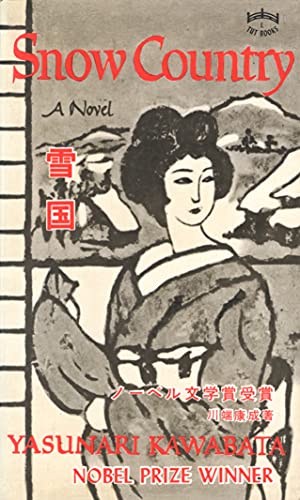
And now for something completely different! The other wintery book I read was Snow Country by Yasunari Kawabata, translated from the Japanese by Edward G. Seidensticker. Originally published in three parts over the course of ten years, the final version emerged as a whole in 1947. Snow Country is a melancholy winter poem in short novel form, frank and unromantic. 

"Snow country" refers to the mountainous region on the western coast of Japan known for its heavy snowfall, where pleasure-seekers go to ski, enjoy the hot springs, drink sake, and enjoy the company of geishas. Over the course of three visits to a hot spring resort in a remote mountain village, a married Tokyo idler (Shimamura) becomes intimate with a young geisha, Komako. There is no pretense that theirs will be a lasting love affair. Hot spring geishas aren't known for being particularly well-trained in music, dance, or song. 

The writing is absorbing, occasionally transcendently beautiful, lovely and sad. So much reflection on "wasted effort:" beauty and talent existing in a snowbound, uncultured village. When Shimamura is with Komako, he is reminded of his own futile enjoyments (hiking mountains; an intended self-published book on ballet, an art he's never seen nor wants to). In snow country, it is clear that time just passes, with nothing to show for us having been there but perhaps a series of diaries read over only by their writer, or a fine cotton cloth that will long outlive its anonymous creator. 

I hope everyone is safe and warm, cozy with their pets or other loved ones. 

-Michael G. 

Tuesday, January 6, 2026

Frills and Thrills by Louise Barnes Gallagher


Sometimes, there are treasures to be found on the free books cart at the entrance to the Ferguson Public Library.

One such treasure was a vintage book called Frills and Thrills by Louise Barnes Gallagher. It's the story of a young woman who matures from creating doll clothes as a child to designing and sewing her own much-admired clothes for college life, modeling at fashion shows, and eventually creating elegant designs for a high fashion couture house. This charming book, published in 1940, is based on the real-life experience of its author.

Not only did Louise Barnes Gallagher in reality design sought-after clothes from the 1920s through the end of the '40s, she also wrote good stories that followed her own personal trajectory while changing enough of it to create characters with interesting dilemmas and developments in the context of compelling historical fiction.  

In Frills and Thrills, we tag along with young Mary Bray beginning in her college years and moving into professional life as she grows in sewing and design skill as well as confidence and competence. We learn how the world of women's fashion design, production, and promotion operates. The story of Mary's professional development is fleshed out by her personal life, which has its share of ups, downs, disappointments, personal sorrows and joys, while unexpected opportunities and influential mentors help her establish professional footing. She's an earnest young woman who - despite hardships in early adulthood - seems to live a charmed life, the latter aspect giving the book much of its compelling readability. A few period-type illustrations add to the appeal of this book.   

More than merely an enjoyable reading experience though, I discovered this book is part of a series of "career books" written as novels for teenage girls and young women. The collection was published by Dodd, Mead and Company between the 1930s and '60s.   

I was hooked enough by the story of this young designer to search and find what I could about this author and this series of books. That led to a few surprises, though it was unsurprising to learn that the series was created to expose girls and young women to the day-to-day activities of a variety of occupations and professions. There are the expected ones for the time period during which they were produced: nursing, teaching, nutrition, home economy, social work and library work, for instance. There were also novels to introduce readers to fields a girl might not have considered, such as police work, X-ray technician, radio interviewer, physician, "sky librarian," "mountain nurse," "sky nurse" - and many more.

I found myself wishing I had known of these books when I was in high school, as by the early 1970s there were few obvious professional role models for girls in my middle class world, following a nationwide cultural campaign waged after World War II that persisted into the 1960s, designed initially to push women out of jobs and to generally discourage professional aspirations by emphasizing the primary importance for women of family creation and homemaking. Men returning from that war needed their jobs back, after all. This campaign - waged in newspapers and national magazines - set the women's movement back significantly during the mid-20th century. It was aimed at my mother's generation and was largely successful, at least for middle- and upper-class women, leaving their daughters with a limited view of occupational possibilities. Our role models then were teachers, nurses and secretaries. These jobs were typically thought of as ones to occupy only until starting a family. That was the era when child rearing, homemaking and personal beauty enhancement were the chief focus of women's magazines. In Catholic communities there was another female role model of course: nun. 

Yet somehow - concurrently - these richly instructive counterculture books got written and published...and then went out of fashion. 

I found another surprise in my search for more of these vintage titles: they are nearly impossible to find! The Library of Congress has them, as do a number of university libraries. But I could not find them in our library catalogue, and they are scarce in the used book market, and pricey! Searching from a long list of titles in this series, I found very few available among several used book websites including ThriftBooks, Better World Books, AbeBooks, eBay, and Amazon. Ginger Lee, War Nurse by Dorothy Deming for example, is offered on one bookseller's site for $125. Another title in the series was listed for $200. Many of the titles I couldn't find for sale anywhere. Apparently they have become coveted collectors' items that quickly get snatched up.

Finally, in Frills and Thrills I learned a fun fact about my home town that surprised me: St Louis was once an important player in the world of fashion. During the earlier part of the last century the nation's most successful clothing designers gathered regularly at our city's upscale hotels to show the new seasonal styles to buyers from America's major department stores. Chapter 15 of this book is titled St. Louis Preview; it's where the story's protagonist makes some significant career progress.  

Louise Barnes Gallagher wrote two sequels to Frills and Thrills. I looked - in vain - for them in library catalogs and on used booksellers' websites. I would like to read more about fictional Mary Bray and where her charmed life took her. My fruitless search told me I'm not the only one who loved this book and keeps it in their book collection. 

- Marianne W.